
YatoruSenpai
Administrator
In this world, adventurers are free to choose a single race or forge a unique mixed heritage, blending cultures, appearances, and innate talents—each combination shaping how the world responds to them. Every race carries its own distinct benefits: some are born with heightened strength or resilience, others with sharp intellect, arcane affinity, or an instinctive bond with nature. Many races have ancestral homelands where their societies flourish—dwarves and giant-kin thrive in mountain halls and deep forges, elves and fey-touched peoples dwell within ancient forests or hidden glades, while humans, gnomes, and other adaptable folk spread across plains, coasts, and bustling cities. Mixing races allows characters to inherit traits, traditions, and perspectives from both lineages, often granting uncommon versatility or rare abilities, though such individuals may face unique expectations or prejudice depending on where they travel. Some races are more closely tied to specific regions, climates, or cultures, while others wander freely, integrating wherever opportunity calls. All racial combinations are possible and accepted in character creation—with the sole exception of Vampires and Werewolves, whose bloodlines are forbidden to mix due to balance.

Succubus/Incubus

A succubus is a demon in female form, or supernatural entity, that appears in the dreams, taking form of a woman in order to seduce men or women, usually through sexual activity. They have sharp claws, a sharp tail, sharp teeth, and bladed wings, however the tail and wings can be hidden to keep their identity a secret as a demon. The combat style of a succubus usually involves sex appeal based combat and pheromone manipulation, but can also fight normally. The Incubus does the same but is the male counterpart. Both having a symbiotic relationship as the incubi collect fertile eggs from human females for the Succubi to collect an active sperm from a Human male to birth a new demonic species. {Founded On Strahk}
Succubus/Incubus
A succubus is a demon in female form, or supernatural entity, that appears in the dreams, taking form of a woman in order to seduce men or women, usually through sexual activity. They have sharp claws, a sharp tail, sharp teeth, and bladed wings, however the tail and wings can be hidden to keep their identity a secret as a demon. The combat style of a succubus usually involves sex appeal based combat and pheromone manipulation, but can also fight normally. The Incubus does the same but is the male counterpart. Both having a symbiotic relationship as the incubi collect fertile eggs from human females for the Succubi to collect an active sperm from a Human male to birth a new demonic species. {Founded On Strahk}
Elves

Elves are A type of human-shaped supernatural beings. In medieval germanic-speaking cultures, Elves seem generally to have been thought of as beings with magical powers and supernatural beauty, ambivalent towards everyday people and capable of either helping or hindering them. Subspecies- Drow, Snow Elf, Wood Elf, High Elves, and Sea Elves. {Founded On On Elysium, Parros and Strahk}
Vampires

Vampire- A Vampire is a Nocturnal Species of Cannibals. These creatures/ Species are depicted as Pale humanoid creatures able to take form of their previous Life like form before being infected with a disease called Porphyria. Vampires are stated to be quite agile creatures with tremendous strength equivalent to three grown men. Though its also stated due to their Nightly life any form of sunlight thins the creatures Skin to the Point that it can be cleaved in half cleanly. Due to this Vampires have been noted to utilize Aqua Ethereal Magic to act as a lubricant and transform themselves into Mist. {Founded On Strakh}
Werewolves

Werewolves or occasionally Lycanthrope are humans with the ability to shapeshift into a wolf, either purposely or after being placed under a curse or affliction. But there are another species of werewolf which are born wolves and later develop their abilities by transforming for the first time through anger (Accidental) or on the full moon (Natural) in which case they can transform anytime afterwards but the wolf must be over 8 years before it can transform at will. {Founded On Beast Island}
Werewolves or occasionally Lycanthrope are humans with the ability to shapeshift into a wolf, either purposely or after being placed under a curse or affliction. But there are another species of werewolf which are born wolves and later develop their abilities by transforming for the first time through anger (Accidental) or on the full moon (Natural) in which case they can transform anytime afterwards but the wolf must be over 8 years before it can transform at will. {Founded On Beast Island}
Wylkea

Long ago a large village of female monk like creatures who lived in peace and harmony. They tended to their fields and never bothered any one, Often giving to those less fortunate. however that all changed when the village was violently attacked by orcs. At the time the large village was reduced greatly in number from 10,000 to just over 500 in a single night. The surviving members sought revenge for the actions taken upon them and thus sought power to do so. It is unknown where these women obtained this power but they have gone threw great strides to keep it secret. They used this power to destroy the bandits who slaughtered their village in a massacre of relative proportions, The only difference is they left no survivors. The wylkea lived above ground for many years until they found themselves committing many of the same unforgivable acts they had once been made to suffer. Fearful of what their actions may lead to, the elders decided it would be best if they moved away from the rest of the world. Thus they traveled far away to the savage land, A land known for being very inhospitable to life. They fled to the “Land Of strakh” and made themselves at home in a empty place to the far left of the land. Here you will find no village of peace just a area of Warring Demons doomed to fight each other for all eternity. As the years passed they have expanded their underground cave system into many far reaches of the land and have split into many branches. It is unknown how many members of the race are actually alive today but they are often found near active volcanoes. It is also not uncommon to find a branch of the race loyal to a certain kingdom that they have built their home under . However, this female species heard about Taberus, and found them very interesting especially since they had the same powers. The Wylkea wanted to find them and live amongst them, this female species were asexual and didn’t need any males to reproduce, but this didn’t stop them from having fun with them or other females. (Only able to use spiritual energy for a basic power) {Founded On Parros}
Apelings

Apelings are direct descendants from a long forgotten Monkey God. This God was extremely joyful and filled with pride, but was one day challenged by an unknown villain. This challenge would see the disappearance of the Monkey God, but an influx in similar lesser creatures known now as Apelings.
They have a more human look but have 5 feet long tails. Most physical characteristics suggest human but they are more closer to primate than man. However, their intelligence, larger size, and more bipedal posture suggest the influence of human traits. Apelings are closer to the size of a small human yet their strength is more comparable to an orc or dwarf than human. They usually have more defined muscles than monkeys although they are still rather slender, keeping a very athletic appearance. Hair and Tail colors range from common black and brown to the more exotic colors such as pink or green. White hair/tails is usually a "sign" of inherent greatness. (Found on Parros)
Lyrans

The constellation of Lyra has long been recognized in Earth’s mythology. Some have even connected it with the Pleiades (for example, Ovid, who mentioned that the seven strings of Lyra equaled the number of the Pleiades). This can be considered the birthplace or womb of the humanoid race within Earth’s area of the Milky Way. All subspecies such as Sirians, Orions, Earth/Terrans, Pleiadians, Vegans, Zeta Reticulans, Centaurian, Altairians(and many lesser-known groups) are descendants of the Lyran races.” (Lyssa Royal & Keith Priest, The Prism of Lyra). Lyra has played an important part in the History of Earth and Mankind, as did the Sirians and Pleiadians. (Together, they are often referred to as the ‘Lyran Group‘). When it comes to what man (homo sapiens) physically looks like, the Lyrans (and the Pleiadians -but they are Lyran descendants) are the main influence, especially for the Caucasian race. Earth’s mythologies are filled with stories of cat people. These refer to an actual race that did interact with Earth in a distant past. These cat people, like many other species, come from the Lyra Constellation. Lyssa Royal: “One other Lyran subgroup is also mammal and what you would consider to be humanoid – but whose physical appearance resembles what you call the feline kingdom on your world. They are not cat people, but humanoids who have catlike qualities. They are very agile and strong. The nose is not predominant but catlike, if you can imagine the nose of a cat. The ears are neither human nor catlike but somewhat of a cross, a little pointed, not very much, but a little. The mouths are very gentle and small. (Many times when extraterrestrials look at the human face, to them the human face is overwhelmed by the mouth.) These catlike entities have very small, delicate and what you would call dainty mouths. The eyes are very pronounced, large and catlike, with a second lid. Again, these qualities developed from the specific environment they have placed themselves within over generations. They do not have fur. However, there is a protective layer of what you could consider peach fuzz over the skin because of the harsh ultraviolet radiation on their indigenous planet – it simply protected the skin. Any primitive interaction with these entities on your world may report that they are cat people – they are not. They are humanoid.” {Founded On Strakh}
The constellation of Lyra has long been recognized in Earth’s mythology. Some have even connected it with the Pleiades (for example, Ovid, who mentioned that the seven strings of Lyra equaled the number of the Pleiades). This can be considered the birthplace or womb of the humanoid race within Earth’s area of the Milky Way. All subspecies such as Sirians, Orions, Earth/Terrans, Pleiadians, Vegans, Zeta Reticulans, Centaurian, Altairians(and many lesser-known groups) are descendants of the Lyran races.” (Lyssa Royal & Keith Priest, The Prism of Lyra). Lyra has played an important part in the History of Earth and Mankind, as did the Sirians and Pleiadians. (Together, they are often referred to as the ‘Lyran Group‘). When it comes to what man (homo sapiens) physically looks like, the Lyrans (and the Pleiadians -but they are Lyran descendants) are the main influence, especially for the Caucasian race. Earth’s mythologies are filled with stories of cat people. These refer to an actual race that did interact with Earth in a distant past. These cat people, like many other species, come from the Lyra Constellation. Lyssa Royal: “One other Lyran subgroup is also mammal and what you would consider to be humanoid – but whose physical appearance resembles what you call the feline kingdom on your world. They are not cat people, but humanoids who have catlike qualities. They are very agile and strong. The nose is not predominant but catlike, if you can imagine the nose of a cat. The ears are neither human nor catlike but somewhat of a cross, a little pointed, not very much, but a little. The mouths are very gentle and small. (Many times when extraterrestrials look at the human face, to them the human face is overwhelmed by the mouth.) These catlike entities have very small, delicate and what you would call dainty mouths. The eyes are very pronounced, large and catlike, with a second lid. Again, these qualities developed from the specific environment they have placed themselves within over generations. They do not have fur. However, there is a protective layer of what you could consider peach fuzz over the skin because of the harsh ultraviolet radiation on their indigenous planet – it simply protected the skin. Any primitive interaction with these entities on your world may report that they are cat people – they are not. They are humanoid.” {Founded On Strakh}
Centaurs

Centaurs are a nomadic race, and are hunter-gatherers by nature. Generally Centaurs will travel in tribes most often sleeping under the stars or the shelter of trees. Centaurs tend to be brutal if anyone shows weakness or falls behind the tribe won’t hesitate to leave them behind. Because of this Centaurs who are abandoned sometimes will seek out in settle into civilization. Walking the line between beast and man, centaurs have a human torso with a equine lower half. Centaurs commonly have the body of a horse but there are some variants such as Deer and Elk. Centaurs also are intune with nature and tend to do well in nature based magic, many become druids. (Found on Parros)
Minotaurs

Although many legendary minotaurs have gone down in history as being evil monsters that slaughter any who enter their labyrinths, they aren't always bad. A smaller, more intelligent band of minotaurs have gone to live a more peaceful life trying to settle with fey and mortals alike. However, they always seem to run into the reputation that their more brutal cousins have created. Some minotaurs have learned to use this to their advantage by becoming the muscle to mercenary parties or guards to VIP.
Minotaurs are very diverse in physical qualities. They sometimes bare very large bull horns or none at all. Sometimes their features are more human in nature, other times it's like a bull simply learned to walk upright. Their hair colors tend to stay in different shades of brown or grey. Minotaurs typically like to wear different forms of chains or jewelry around their necks or in their horns. It comes from a more primal desire to collect beautiful treasures.
This race of minotaur tends to be on a more advanced and kind level then the evil beasts they branched off from, so they commonly range from a lawful good to a true neutral. Bloodlust, however, can be a curse that spikes among individuals of these communities, so evil aligned minotaurs have been found working for the deadliest of criminals around. The way they spend their lives is all determined by whether or not society has accepted them. If people are blind to the minotaur's true nature and discriminate against them, the minotaurs tend to show them what they have been suppressing. When that happens, avoid those horns at all costs. (Found in the Caverns.-Strakh)
Giants

Giants are humanoid creatures, usually of great strength and size. Most giants have vision equivalent to that of a human, though some have the capacity to see well in low light or total darkness as well. As a group, they have no other special abilities. They are immune to almost all diseases, and have a slight resistance to poison. Dwarves as a race are experienced at fighting giants, so they are more adept in combat with them. Most giants have superior senses to most humans. In general they can see and hear twice as well. The cloud giant, hill giant and stone giant species have a particularly good sense of smell. The appearance of giants varies according to the type of giant but they are generally humanoid in appearance, just much larger. Their bone structure is more dense than that of humans, giving them extra toughness but slowing them down a little. (Found in Strahk)
Dragon Kin

Prideful and Imposing, the Dragonkin that inhabit the realm of Zrada share few traits and ideals, but all of them have an appreciation for fine metalworking, as well as for rare metals themselves, something they share with true dragons, and a taste for the more precious things in life, such as rare solitude, the rush of combat, and bonds between close allies. They also happen to believe in furthering the potential of their powerful bodies, believing that honing the natural power and fortitude is one thing that makes them exceptional. Beyond this, however, most Dragonkin are as varied as most humans are in their personal belief systems.
To other races, Dragonkin believe they are superior in nature, and therefore usually can either come off as magnanimous or condescending, with reactions varying between individuals, and are usually found in all cities in some quantity or another. The large majority are nomadic barbarians, despite those who live in the cities. Elves, in particular, along with Merfolk at times, seem to bear the brunt of ridicule or jest from Dragonkin, as they are seen as being particularly frail among the races, no matter how untrue individual cases may be.
True Dragons tend to have mixed opinions, as well, regarding Dragonkin. Some may find them as lesser siblings, while others may conclude that they are mere mockeries of their race. (Found in Shadow Dragon Mountain - Beast Island and Dragon Mountain - Strakh)
Daemon

Daemon unlike the Succubi and Incubi are highly malicious creatures born from the despair and darkest spots of Zrada, said to be born from the dark manipulation of Myrus these forms of Abominations stand about Eight Feet and Eleven Inches max with the muscle tones similar to a human body builder. Though as strong as a grown human Male these creatures rely less on physical strength and more on their Magical Prowess and Intelligence which has even been stated for far exceed that of Ancient Elves. Having a sadistic personality these creatures tend to enjoy tormenting the poor souls caught by their elaborate traps; though it has been shown that the Daemon have a natural weakness to the Holy and Celestial Magics to the point even Druid Arts can prove lethal to a Daemon. As such this Species tends to stay within the darkness only to come out into the World of Strakh during the fall of the Sun (Dusk) towards Dawn using this period of time itself to feed on the Souls of those they torment. Daemon Weaponry comprises of Chitin, Bone, Infernal Iron, and Ebony alloy thus giving their gear a more intimidating design. (Found in Strakh/ The Nine Hells)
Fira

The Fira are a race of fire-born humanoids whose very presence seems warmed by an inner blaze. Their most striking feature is their flame-like hair, which flows and flickers as living fire, shifting in hue from ember-gold to roaring orange depending on mood and magical exertion. Their skin often bears a sun-kissed bronze or ash-touched tone, faintly glowing along veins or scars where heat gathers beneath the flesh. Eyes burn with molten intensity—amber, crimson, or gold—revealing their natural attunement to fire magic, which they wield as effortlessly as breath. Clad often in dark metals or heat-resistant leathers, the Fira appear both regal and dangerous, as if forged in flame and tempered by will. (Found in Parros and the Nine Hells)
The Fira are a race of fire-born humanoids whose very presence seems warmed by an inner blaze. Their most striking feature is their flame-like hair, which flows and flickers as living fire, shifting in hue from ember-gold to roaring orange depending on mood and magical exertion. Their skin often bears a sun-kissed bronze or ash-touched tone, faintly glowing along veins or scars where heat gathers beneath the flesh. Eyes burn with molten intensity—amber, crimson, or gold—revealing their natural attunement to fire magic, which they wield as effortlessly as breath. Clad often in dark metals or heat-resistant leathers, the Fira appear both regal and dangerous, as if forged in flame and tempered by will. (Found in Parros and the Nine Hells)
Valkyries

The Valkyries are an all-female race of divine warrior-maidens, their presence both awe-inspiring and otherworldly. Instead of wings, each Valkyrie bears a crown of majestic deer antlers, branching high and wide, often etched with faint runes or adorned with charms, feathers, or sacred bindings that mark rank and honor. Their physiques are tall, powerful, and graceful, forged for battle yet carrying an unmistakable celestial elegance. Eyes shimmer like moonlit steel or storm-lit skies, reflecting their role as arbiters of fate and guardians of fallen heroes. Clad in finely wrought armor that blends natural motifs with divine craftsmanship, the antlered Valkyries embody the balance between the wild and the sacred—huntresses of destiny who stride between mortal realms and the halls of the honored dead. Natural weilders of Holy, light and Druidic magic. (Usually found in the heavens or Strahk or even Parros)
The Valkyries are an all-female race of divine warrior-maidens, their presence both awe-inspiring and otherworldly. Instead of wings, each Valkyrie bears a crown of majestic deer antlers, branching high and wide, often etched with faint runes or adorned with charms, feathers, or sacred bindings that mark rank and honor. Their physiques are tall, powerful, and graceful, forged for battle yet carrying an unmistakable celestial elegance. Eyes shimmer like moonlit steel or storm-lit skies, reflecting their role as arbiters of fate and guardians of fallen heroes. Clad in finely wrought armor that blends natural motifs with divine craftsmanship, the antlered Valkyries embody the balance between the wild and the sacred—huntresses of destiny who stride between mortal realms and the halls of the honored dead. Natural weilders of Holy, light and Druidic magic. (Usually found in the heavens or Strahk or even Parros)
Kitsune

Kitsune are a mystical, fox-born race rooted in Japanese folklore and well suited to a fantasy setting where spirits and mortals coexist. In legend, kitsune are fox spirits who gain intelligence, magical power, and longevity as they age. In a fantasy race interpretation, they are typically humanoid in form, bearing fox ears, sharp eyes, and one or more flowing tails. Their bodies are graceful rather than physically imposing, favoring agility, balance, and elegance over brute strength. A defining trait of kitsune is their connection to illusion and transformation. They are natural shapeshifters, capable of disguising themselves as humans or other creatures. Traditionally, they are said to favor the form of human women, and folklore often describes kitsune as primarily female in appearance, even when their true nature is ambiguous. This aspect carries into fantasy settings, where kitsune societies are usually female-led or matriarchal, and male kitsune are rare, secretive, or less frequently encountered. Kitsune grow stronger with age, symbolized by the number of tails they possess. Young kitsune may have a single tail, while ancient and powerful ones can have many, sometimes up to nine. Each additional tail represents greater magical mastery, wisdom, and spiritual refinement. Losing a tail is considered a great disgrace or trauma. Magically, kitsune excel in illusion, charm, and spiritual magic. They can conjure ghostly flames, weave convincing illusions, influence emotions, and cloud the minds of others. Rather than direct destruction, their magic focuses on misdirection, deception, and subtle control. In battle, they rely on cleverness and magic rather than raw force. Culturally, kitsune are often portrayed as tricksters, but not inherently evil. They delight in clever pranks, tests of character, and outwitting the arrogant. In fantasy worlds, kitsune may act as secret guardians of sacred places, manipulators behind political events, or wandering spirits who teach lessons through deception. Loyalty and respect are deeply valued—those who treat a kitsune with kindness may gain a powerful ally, while those who insult or exploit them may face elaborate revenge. Kitsune represent a race of beauty, mystery, and cunning—ancient fox spirits walking the line between mortal and magical, remembered in legend as beguiling women whose smiles may conceal wisdom, mischief, or danger. (Found On Elysium)
Kitsune are a mystical, fox-born race rooted in Japanese folklore and well suited to a fantasy setting where spirits and mortals coexist. In legend, kitsune are fox spirits who gain intelligence, magical power, and longevity as they age. In a fantasy race interpretation, they are typically humanoid in form, bearing fox ears, sharp eyes, and one or more flowing tails. Their bodies are graceful rather than physically imposing, favoring agility, balance, and elegance over brute strength. A defining trait of kitsune is their connection to illusion and transformation. They are natural shapeshifters, capable of disguising themselves as humans or other creatures. Traditionally, they are said to favor the form of human women, and folklore often describes kitsune as primarily female in appearance, even when their true nature is ambiguous. This aspect carries into fantasy settings, where kitsune societies are usually female-led or matriarchal, and male kitsune are rare, secretive, or less frequently encountered. Kitsune grow stronger with age, symbolized by the number of tails they possess. Young kitsune may have a single tail, while ancient and powerful ones can have many, sometimes up to nine. Each additional tail represents greater magical mastery, wisdom, and spiritual refinement. Losing a tail is considered a great disgrace or trauma. Magically, kitsune excel in illusion, charm, and spiritual magic. They can conjure ghostly flames, weave convincing illusions, influence emotions, and cloud the minds of others. Rather than direct destruction, their magic focuses on misdirection, deception, and subtle control. In battle, they rely on cleverness and magic rather than raw force. Culturally, kitsune are often portrayed as tricksters, but not inherently evil. They delight in clever pranks, tests of character, and outwitting the arrogant. In fantasy worlds, kitsune may act as secret guardians of sacred places, manipulators behind political events, or wandering spirits who teach lessons through deception. Loyalty and respect are deeply valued—those who treat a kitsune with kindness may gain a powerful ally, while those who insult or exploit them may face elaborate revenge. Kitsune represent a race of beauty, mystery, and cunning—ancient fox spirits walking the line between mortal and magical, remembered in legend as beguiling women whose smiles may conceal wisdom, mischief, or danger. (Found On Elysium)
Okami-kin

The Okami-Kin are a proud humanoid race bearing the sharp features of wolves—furred ears, keen fangs, and expressive tails that reflect mood and intent. Their builds are lean yet powerfully muscled, designed for speed, endurance, and sudden bursts of ferocity. Most Okami-Kin are male, standing as warriors, scouts, and storm-callers within their society. They primarily inhabit Elysium’s Kitsunkami terrain, a land of wind-carved peaks, rolling highlands, and sacred forests, which they share in an uneasy but time-honored coexistence with the Kitsune. Naturally attuned to Lightning and Wind magic, Okami-Kin channel storms through their bodies, enhancing their physical prowess with crackling speed, sharpened senses, and thunderous strength. When they fight, the air itself seems to howl alongside them, as if the storm recognizes its own. (Found on Elysium)
Dwarves

Dwarves are a stout and enduring race, shaped as much by stone as by flesh, with broad frames, powerful limbs, and weathered features that speak of centuries spent beneath the earth. Their skin often carries tones of granite, iron, or deep clay, and their eyes gleam like polished gems or molten ore in low light. Deeply attuned to earth magic, Dwarves feel the pulse of the world through stone and soil, allowing them to shape rock, reinforce their bodies with earthen resilience, and sense faults or hidden riches beneath the ground. Their beards and hair are worn as symbols of pride and lineage, often braided with metal rings or carved talismans. Living in vast mountain holds and subterranean cities, Dwarves are master smiths and builders, unyielding as the bedrock they revere and as steadfast as the mountains they call home. (Found on Strahk)
Humans

Humans are the most widespread and adaptable race on Zrada, found in every climate and culture, from bustling capitals to forgotten frontiers. Physically varied and endlessly resilient, they possess no single defining trait beyond their remarkable versatility. Unlike many races, humans lack a natural affinity for magic, unable to wield it innately without external means such as artifacts, rituals, or long study. However, this absence is balanced by a unique trait: humans can reproduce with any race, giving rise to countless hybrid lineages that shape the world’s bloodlines and histories. It is through this adaptability—of body, mind, and spirit—that humanity thrives, weaving itself into the fate of every land and people across Zrada. (Found on Elysium, Parros, and Strahk)
Gnomes

Gnomes are a small-statured but lively race, known for their sharp features, bright eyes, and ever-present expressions of curiosity and mirth. Typically found across Elysium, they favor high places—floating isles, cliffside villages, and wind-swept plains—where the air is always in motion. Gnomes possess a natural affinity for wind magic, allowing them to bend breezes to their will, soften falls, quicken their movements, and carry whispered messages across great distances. Their hair often stands tousled as if caught in a constant breeze, and their clothing is light, layered, and designed to dance with the wind. Quick-witted and inventive, Gnomes treat the air as both companion and tool, thriving where others struggle against the endless skies. (Found on elysium)
Changlings

Changelings are a versatile and enigmatic race of natural shapeshifters, feared and admired for their adaptability and innate magic. In their true form, changelings closely resemble elves, sharing slender builds, long limbs, and finely shaped features. However, closer inspection reveals unsettling differences: their teeth are sharper, more predatory, hinting at their inhuman nature. Their eyes often appear slightly reflective or unusually colored, and their expressions can feel subtly unnatural, as if they are always on the verge of becoming someone; or something else. The defining trait of changelings is their absolute mastery of transformation. A changeling can alter their body into anything they have seen, whether living or inanimate, and whether the change is partial or complete. They may shift only their hands into claws, their eyes into those of a beast, or their entire form into another humanoid, animal, or creature. More skilled changelings can mimic voices, scents, and mannerisms with frightening accuracy, making them nearly impossible to distinguish from the original. Transformation is not illusion but true physical change, though it is fueled by magic rather than biology. Because of this, changelings are natural magic users, able to draw on arcane energy instinctively from birth. Magic flows through their bodies as easily as breath, and even those without formal training can manipulate it to maintain transformations or enhance their senses and reflexes. Changelings are not a single, uniform people. They vary between different types, each reflecting a different magical inclination: Some are bestial changelings, favoring monstrous or animal forms and enhanced physical traits. Others are mimic changelings, specializing in perfectly copying individuals and infiltrating societies. There are also arcane changelings, who blend shapeshifting with spellcraft, altering their forms in unnatural or symbolic ways. Rare spirit-aligned changelings can take on partially ethereal or elemental traits. Culturally, changelings tend to be adaptable and secretive, often living among other races rather than forming large, visible societies of their own. Many learn to hide their true nature to avoid fear or persecution, while others embrace their abilities as spies, scouts, performers, or magi. Identity is a fluid concept among changelings; names, faces, and even genders may change over the course of a lifetime. (Found on Parros)
Kharuun (Custom By Cairo)
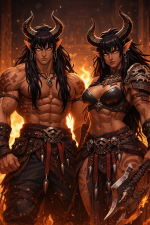
The Horned Kin, often called Kharuun by scholars of Zrada, are a formidable race of horned humanoids whose appearance alone inspires fear and awe. Towering and powerfully built, they possess dense, battle-hardened musculature, long dark hair, sharp elven-like ears, and sweeping horns that curve from their skulls; each horn pattern marking lineage, status, and personal achievement. Their eyes burn with ember-like intensity, reflecting their primal nature, while ritual scars, tattoos, and carved markings are common, each telling the story of battles survived and strength proven. Their physical might rivals that of werewolves and ogres alike; they possess the raw power to tear through steel, shatter shields with bare hands, and endure wounds that would fell most mortal races. Culturally, the Kharuun are deeply tribal, valuing strength, honor, and survival above all else. They do not kneel to kings or crowns, instead organizing themselves into clans led by a strict hierarchy of power and respect. At the top stands the War Chieftain, the strongest and most battle-proven among them, supported by Elders of the Horn, veterans whose wisdom is earned through decades of warfare. Beneath them are the Bloodbound Warriors, elite fighters sworn to defend the clan, followed by hunters, crafters, and shamans who commune with ancestral spirits and primal forces. Weakness is not despised, but it is challenged—every Kharuun is expected to grow stronger or be left behind. Though often labeled as savages by outsiders, the Horned Kin possess a complex code of honor, deep loyalty to their own, and a spiritual bond to fire, war, and the ancient land they claim as sacred.
-----------------------------------------------------
Hierarchy of the Kharuun (Horned Kin)
War Chieftain (Kragh-Mor)
The War Chieftain is the undisputed leader of a tribe, chosen not by blood alone, but by absolute dominance. To claim this rank, a Kharuun must defeat the reigning chieftain or prove unmatched strength through ritual combat witnessed by the clan. The Kragh-Mor leads the tribe in war, decides territorial claims, and speaks for the clan in dealings with outsiders. A weak chieftain is swiftly challenged—and swiftly replaced.
Elders of the Horn (Varkuun)
Elders are veteran warriors who have survived countless battles and earned the right to guide the tribe. Their horns are often carved or bound with metal rings denoting victories and wisdom gained. Though they no longer lead charges, their voices carry immense weight, advising the War Chieftain on strategy, law, and tradition. Disrespecting an Elder is seen as disrespecting the tribe itself.
Bloodbound Champions (Thar-Kuun)
These are the strongest and most feared warriors beneath the chieftain—fighters who have proven themselves by slaying powerful beasts, rival champions, or enemy leaders. Bloodbound Champions act as personal guards, war leaders, and executioners. Their bodies are marked with ritual scars and war paint infused with ash and blood.
Horn Wardens (Graakh)
Horn Wardens enforce tribal law, guard sacred grounds, and maintain discipline within the clan. They are responsible for settling disputes through sanctioned combat and ensuring no member brings dishonor upon the tribe. Wardens are chosen for loyalty and unwavering resolve rather than brute strength alone.
Fang Hunters (Rukhaal)
Hunters form the lifeblood of the tribe, tracking massive beasts, rival creatures, and dangerous prey. Their hunts are rites of passage, and their trophies determine social standing. Fang Hunters are often the first to engage threats beyond tribal lands.
Forge-Born & Bone-Crafters (Molgra)
These artisans craft weapons, armor, and tools using bone, stone, iron, and hides. Though not front-line warriors, they are deeply respected, as a poorly forged blade is considered a death sentence. Many Molgra are also warriors, combining craft with combat.
Spirit Shamans (Zha’Ruun)
Shamans commune with ancestral spirits, primal forces, and the echoes of fallen warriors. They guide rites, bless weapons, interpret omens, and tend to the wounded through spiritual means. Their authority rivals that of Elders during times of omen or spiritual unrest.
Proven Kin (Drakka)
Adult Kharuun who have completed the Trial of Blood—usually involving the slaying of a dangerous beast or survival of ritual combat—are recognized as full tribal members. They may rise through any rank through merit and strength.
Unproven (Kesh)
Youth and initiates who have not yet proven their strength. They train relentlessly, serve the tribe, and are watched closely. Survival alone is not enough; they must demonstrate courage and growth.
Outcast or Broken Horn (Skarr-Null)
Those who betray the tribe, flee battle, or violate sacred law are stripped of status and often marked by broken horns. Exile is common, though some are executed publicly to reinforce tribal law.
The Horned Kin, often called Kharuun by scholars of Zrada, are a formidable race of horned humanoids whose appearance alone inspires fear and awe. Towering and powerfully built, they possess dense, battle-hardened musculature, long dark hair, sharp elven-like ears, and sweeping horns that curve from their skulls; each horn pattern marking lineage, status, and personal achievement. Their eyes burn with ember-like intensity, reflecting their primal nature, while ritual scars, tattoos, and carved markings are common, each telling the story of battles survived and strength proven. Their physical might rivals that of werewolves and ogres alike; they possess the raw power to tear through steel, shatter shields with bare hands, and endure wounds that would fell most mortal races. Culturally, the Kharuun are deeply tribal, valuing strength, honor, and survival above all else. They do not kneel to kings or crowns, instead organizing themselves into clans led by a strict hierarchy of power and respect. At the top stands the War Chieftain, the strongest and most battle-proven among them, supported by Elders of the Horn, veterans whose wisdom is earned through decades of warfare. Beneath them are the Bloodbound Warriors, elite fighters sworn to defend the clan, followed by hunters, crafters, and shamans who commune with ancestral spirits and primal forces. Weakness is not despised, but it is challenged—every Kharuun is expected to grow stronger or be left behind. Though often labeled as savages by outsiders, the Horned Kin possess a complex code of honor, deep loyalty to their own, and a spiritual bond to fire, war, and the ancient land they claim as sacred.
-----------------------------------------------------
Hierarchy of the Kharuun (Horned Kin)
War Chieftain (Kragh-Mor)
The War Chieftain is the undisputed leader of a tribe, chosen not by blood alone, but by absolute dominance. To claim this rank, a Kharuun must defeat the reigning chieftain or prove unmatched strength through ritual combat witnessed by the clan. The Kragh-Mor leads the tribe in war, decides territorial claims, and speaks for the clan in dealings with outsiders. A weak chieftain is swiftly challenged—and swiftly replaced.
Elders of the Horn (Varkuun)
Elders are veteran warriors who have survived countless battles and earned the right to guide the tribe. Their horns are often carved or bound with metal rings denoting victories and wisdom gained. Though they no longer lead charges, their voices carry immense weight, advising the War Chieftain on strategy, law, and tradition. Disrespecting an Elder is seen as disrespecting the tribe itself.
Bloodbound Champions (Thar-Kuun)
These are the strongest and most feared warriors beneath the chieftain—fighters who have proven themselves by slaying powerful beasts, rival champions, or enemy leaders. Bloodbound Champions act as personal guards, war leaders, and executioners. Their bodies are marked with ritual scars and war paint infused with ash and blood.
Horn Wardens (Graakh)
Horn Wardens enforce tribal law, guard sacred grounds, and maintain discipline within the clan. They are responsible for settling disputes through sanctioned combat and ensuring no member brings dishonor upon the tribe. Wardens are chosen for loyalty and unwavering resolve rather than brute strength alone.
Fang Hunters (Rukhaal)
Hunters form the lifeblood of the tribe, tracking massive beasts, rival creatures, and dangerous prey. Their hunts are rites of passage, and their trophies determine social standing. Fang Hunters are often the first to engage threats beyond tribal lands.
Forge-Born & Bone-Crafters (Molgra)
These artisans craft weapons, armor, and tools using bone, stone, iron, and hides. Though not front-line warriors, they are deeply respected, as a poorly forged blade is considered a death sentence. Many Molgra are also warriors, combining craft with combat.
Spirit Shamans (Zha’Ruun)
Shamans commune with ancestral spirits, primal forces, and the echoes of fallen warriors. They guide rites, bless weapons, interpret omens, and tend to the wounded through spiritual means. Their authority rivals that of Elders during times of omen or spiritual unrest.
Proven Kin (Drakka)
Adult Kharuun who have completed the Trial of Blood—usually involving the slaying of a dangerous beast or survival of ritual combat—are recognized as full tribal members. They may rise through any rank through merit and strength.
Unproven (Kesh)
Youth and initiates who have not yet proven their strength. They train relentlessly, serve the tribe, and are watched closely. Survival alone is not enough; they must demonstrate courage and growth.
Outcast or Broken Horn (Skarr-Null)
Those who betray the tribe, flee battle, or violate sacred law are stripped of status and often marked by broken horns. Exile is common, though some are executed publicly to reinforce tribal law.
Anubari (Custom By Cairo)
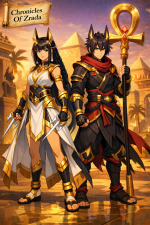
The Anubari are a sacred demi-human race believed to have been shaped by the divine will of the Jackal Gods, much like Kitsune were shaped by Inari and Ōkami by the mountain spirits. Neither fully mortal nor divine, the Anubari exist as chosen intermediaries; guardians of spiritual thresholds, arbiters of hidden laws, and quiet watchers of fate. To ancient civilizations, they were not merely people, but omens made flesh, their presence signaling judgment, transition, or protection. Legends say the Anubari were born when the Jackal Gods shed fragments of their essence to ensure the mortal world would never be left unguided at moments of death, war, or spiritual passage. These fragments crystallized into bloodlines, creating a race that walks upright like humans yet bears the ears, tails, and spiritual instincts of jackals. As with Kitsune, age and experience deepen an Anubari’s spiritual potency, refining their abilities and sharpening their connection to unseen realms. Anubari bloodlines are often said to descend from three sacred archetypes, each echoing one of the Jackal Gods.
To human civilizations, the Anubari are spoken of in hushed tones; never hunted, never enslaved, and rarely opposed openly. Like Kitsune, they are respected even by kings, often treated as sacred guests or divine messengers. Shrines dedicated to the Jackal Gods sometimes double as sanctuaries for Anubari wanderers. Stories say that when an Anubari walks through a city: The guilty feel uneasy, the dying dream vividly, and the dead grow silent. The Anubari do not believe in absolute good or evil; only proper passage. Life must end. Death must mean something. Paths must remain open. What is sacred must endure, they choose how they act, but never whether they answer the call of balance.
-----------------------------------------------------
Archetypes of the Anubari
Anubis Lineage
Descendants of Anubis (Inpu/Anpu) embody judgment, preservation, and spiritual law. These Anubari serve as mortuary guardians, assassins of the guilty, soul-guides, and keepers of forbidden rites. They possess an innate sense for moral imbalance and are often chosen to oversee rites similar to the Weighing of the Heart. Much like elder Kitsune who act as judges or shrine guardians, Pathwardens command immense respect and quiet fear.
Wepwawet Lineage
Tracing their blood to Wepwawet, these Anubari are scouts, warriors, and path-openers. They are said to “walk ahead of destiny,” clearing spiritual and physical obstacles alike. Comparable to wandering Ōkami who guide travelers through mountains and war-torn lands, Wayfinders are often seen before great conflicts or turning points in history.
Duamutef Lineage
Linked to Duamutef, these Anubari protect what must be preserved—bodies, relics, memories, and sacred spaces. They are ritualists and wardens, ensuring that protection and order remain intact. Like Kitsune caretakers of shrines, Sanctifiers safeguard ancient rites and the continuity of tradition.
-----------------------------------------------------
Racial Traits of the Anubari
Though all Anubari are Children of the Veiled Path, the blood of the Jackal Gods expresses itself differently depending on lineage. These differences do not divide the race—they complete it, ensuring judgment, guidance, preservation, and dominion remain in balance.
Traits Shared by All Anubari Lineages
Veilbound Presence
All Anubari are born partially attuned to the Veil, the threshold between life and death. This grants them an innate awareness of spiritual boundaries, lingering souls, and places heavy with endings. Spirits instinctively recognize an Anubari as a lawful being of passage, often hesitating or calming in their presence. This trait does not grant control over the dead, but ensures the Anubari are never ignored by the unseen world.
Instinct of Finality
Every Anubari can sense when something has reached its rightful end; or when that end has been unnaturally delayed. This instinct manifests as a quiet certainty rather than prophecy, allowing them to recognize corrupted immortality, false resurrection, or souls denied passage. The Instinct of Finality is what draws Anubari toward imbalance, compelling them to act even when doing so brings personal cost.
Sacred Rites Memory
Anubari inherit an instinctive understanding of funerary rites, preservation customs, and spiritual law. Even without formal education, they know how to honor the dead, seal remains, and perform rites of passage correctly. Violations of burial sanctity cause deep spiritual discomfort to any Anubari nearby, as though a sacred law has been broken in their presence.
Jackal Physiology
All Anubari possess a supernatural physiology shaped by the sacred jackal gods, blending human adaptability with predatory refinement. Their skeletal structure is lighter yet denser than that of humans, allowing explosive movement without sacrificing durability. Digitigrade legs grant them exceptional stride length and balance, while reinforced tendons enable sudden acceleration, silent landings, and abrupt directional changes. Their senses; especially hearing and smell are highly developed, capable of tracking emotional stress, blood, fear, and lingering spiritual residue. Even in humanoid form, subtle traits remain: elongated canines, sharp nails, keen eyes adapted for low light, and an instinctive awareness of territory and threat. This physiology makes the Anubari natural hunters, scouts, and guardians of sacred ground.
Supernatural Body
The Anubari possess a supernatural body reinforced by their bond to the Veil, elevating their physical capabilities beyond mortal limits while remaining controlled and purposeful. Their speed and agility are predatory and precise, allowing rapid reactions, fluid movement, and sustained high-speed pursuit without loss of balance. Their strength is dense and decisive rather than brutish, enabling bone-shattering strikes, overpowering grapples, and the effortless handling of heavy burdens in short, lethal bursts. Exceptional stamina and endurance allow them to function for extended periods with dulled pain, fatigue, hunger, and environmental strain; especially while fulfilling their sacred role, while their durability grants natural resistance to physical trauma, spiritual backlash, and death-aligned corruption. This supernatural physique does not make the Anubari invincible, but it ensures that when they act, their movements carry an undeniable sense of inevitability.
Anubis Lineage — Judges of the Sacred Land
Weighing of the Heart
Anubis-lineage Anubari possess an innate ability to perceive moral and spiritual imbalance within others. This does not reveal thoughts or crimes outright, but manifests as an unmistakable heaviness or clarity when standing before someone whose actions have disrupted the natural order. Lies, false repentance, and spiritual corruption are difficult to conceal from their gaze.
Rite of Preservation
These Anubari instinctively understand how to preserve bodies, souls, and sacred objects against decay; physical or spiritual. Whether through ritual preparation, sealing, or careful intervention, they can prevent corruption without violating the cycle of death. This trait reflects Anubis’s invention of mummification, emphasizing preservation without defiance of finality.
Authority of the Sacred Land
When operating within burial grounds, tombs, or places consecrated to the dead, Anubis-lineage Anubari exert a heightened spiritual authority. Lesser spirits grow subdued, funerary wards strengthen, and ritual stability increases. This authority is passive but unmistakable, marking them as rightful overseers of death’s domain.
Wepwawet Lineage
Path-Opening Instinct
Wepwawet-lineage Anubari possess an enhanced instinct for uncovering hidden routes, broken passages, and blocked spiritual paths. Whether guiding the living through danger or leading the dead toward passage, they can sense where a way should exist; even if none is visible. This makes them unparalleled scouts, guides, and vanguards.
Warpath Resonance
In times of conflict, these Anubari naturally attune to the momentum of battle. They sense shifts in morale, impending clashes, and moments where decisive movement will alter the outcome. This trait does not grant brute strength, but perfect timing—allowing them to strike, advance, or retreat at the most consequential moment.
Herald of Transition
The presence of a Wepwawet-lineage Anubari often precedes great change. Their arrival subtly accelerates movement—journeys begin, armies march, spirits depart. This does not force outcomes, but loosens stagnation, ensuring that what must move forward does so without delay.
Duamutef Lineage
Sanctified Guard
Duamutef-lineage Anubari possess an instinctive ability to protect what is entrusted to them, whether it be a relic, a body, a soul, or a living person. Once they accept guardianship, their resolve becomes absolute. Breaking through their protection; physically or spiritually; requires immense effort.
Corruption Sense
These Anubari are especially sensitive to internal decay: poison, spiritual rot, parasitic magic, and hidden corruption. They can sense when something appears whole but is rotting from within, making them invaluable in detecting cursed artifacts, tainted bloodlines, or compromised sanctuaries.
Ritewarden Endurance
Duamutef-lineage Anubari possess exceptional spiritual and physical endurance when defending sacred duties. As long as they stand in service of preservation, fatigue, pain, and fear dull significantly. This trait reflects Duamutef’s eternal vigilance over the deceased, unwavering and unbroken.
KhentiAmentiu Lineage
Dominion of the Threshold
KhentiAmentiu-lineage Anubari possess an innate authority over liminal spaces where life and death overlap. Doorways, grave borders, execution grounds, and battlefields fall unnaturally silent in their presence. Spirits instinctively lower their hostility, not out of fear, but submission to an ancient order. While this does not grant control over souls, it allows the Anubari to stabilize crossings, preventing chaotic hauntings, mass unrest, or uncontrolled spiritual overflow.
Stillness of the Western King
This lineage radiates an oppressive calm that anchors the surrounding Veil. Sudden spiritual surges, panic-driven hauntings, or volatile death magic become muted near them, as if the world itself is holding its breath. Living beings often feel a deep, instinctual awareness of mortality when standing close—time seems heavier, movements more deliberate. This stillness cannot be forced or wielded aggressively; it is simply present, a reminder that all motion ends.
Sovereign Claim
Once a KhentiAmentiu-lineage Anubari acknowledges a death as rightful, that death becomes spiritually sealed. The soul cannot be forcibly recalled, bound, or resurrected without catastrophic resistance from the Veil itself. This trait does not prevent natural rites or judgment by other Anubari, but it establishes absolute finality against unnatural interference. Because of this power, members of this lineage are rarely permitted to act alone, and their decisions carry immense cultural weight among the Anubari.
The Anubari are a sacred demi-human race believed to have been shaped by the divine will of the Jackal Gods, much like Kitsune were shaped by Inari and Ōkami by the mountain spirits. Neither fully mortal nor divine, the Anubari exist as chosen intermediaries; guardians of spiritual thresholds, arbiters of hidden laws, and quiet watchers of fate. To ancient civilizations, they were not merely people, but omens made flesh, their presence signaling judgment, transition, or protection. Legends say the Anubari were born when the Jackal Gods shed fragments of their essence to ensure the mortal world would never be left unguided at moments of death, war, or spiritual passage. These fragments crystallized into bloodlines, creating a race that walks upright like humans yet bears the ears, tails, and spiritual instincts of jackals. As with Kitsune, age and experience deepen an Anubari’s spiritual potency, refining their abilities and sharpening their connection to unseen realms. Anubari bloodlines are often said to descend from three sacred archetypes, each echoing one of the Jackal Gods.
To human civilizations, the Anubari are spoken of in hushed tones; never hunted, never enslaved, and rarely opposed openly. Like Kitsune, they are respected even by kings, often treated as sacred guests or divine messengers. Shrines dedicated to the Jackal Gods sometimes double as sanctuaries for Anubari wanderers. Stories say that when an Anubari walks through a city: The guilty feel uneasy, the dying dream vividly, and the dead grow silent. The Anubari do not believe in absolute good or evil; only proper passage. Life must end. Death must mean something. Paths must remain open. What is sacred must endure, they choose how they act, but never whether they answer the call of balance.
-----------------------------------------------------
Archetypes of the Anubari
Anubis Lineage
Descendants of Anubis (Inpu/Anpu) embody judgment, preservation, and spiritual law. These Anubari serve as mortuary guardians, assassins of the guilty, soul-guides, and keepers of forbidden rites. They possess an innate sense for moral imbalance and are often chosen to oversee rites similar to the Weighing of the Heart. Much like elder Kitsune who act as judges or shrine guardians, Pathwardens command immense respect and quiet fear.
Wepwawet Lineage
Tracing their blood to Wepwawet, these Anubari are scouts, warriors, and path-openers. They are said to “walk ahead of destiny,” clearing spiritual and physical obstacles alike. Comparable to wandering Ōkami who guide travelers through mountains and war-torn lands, Wayfinders are often seen before great conflicts or turning points in history.
Duamutef Lineage
Linked to Duamutef, these Anubari protect what must be preserved—bodies, relics, memories, and sacred spaces. They are ritualists and wardens, ensuring that protection and order remain intact. Like Kitsune caretakers of shrines, Sanctifiers safeguard ancient rites and the continuity of tradition.
-----------------------------------------------------
Racial Traits of the Anubari
Though all Anubari are Children of the Veiled Path, the blood of the Jackal Gods expresses itself differently depending on lineage. These differences do not divide the race—they complete it, ensuring judgment, guidance, preservation, and dominion remain in balance.
Traits Shared by All Anubari Lineages
Veilbound Presence
All Anubari are born partially attuned to the Veil, the threshold between life and death. This grants them an innate awareness of spiritual boundaries, lingering souls, and places heavy with endings. Spirits instinctively recognize an Anubari as a lawful being of passage, often hesitating or calming in their presence. This trait does not grant control over the dead, but ensures the Anubari are never ignored by the unseen world.
Instinct of Finality
Every Anubari can sense when something has reached its rightful end; or when that end has been unnaturally delayed. This instinct manifests as a quiet certainty rather than prophecy, allowing them to recognize corrupted immortality, false resurrection, or souls denied passage. The Instinct of Finality is what draws Anubari toward imbalance, compelling them to act even when doing so brings personal cost.
Sacred Rites Memory
Anubari inherit an instinctive understanding of funerary rites, preservation customs, and spiritual law. Even without formal education, they know how to honor the dead, seal remains, and perform rites of passage correctly. Violations of burial sanctity cause deep spiritual discomfort to any Anubari nearby, as though a sacred law has been broken in their presence.
Jackal Physiology
All Anubari possess a supernatural physiology shaped by the sacred jackal gods, blending human adaptability with predatory refinement. Their skeletal structure is lighter yet denser than that of humans, allowing explosive movement without sacrificing durability. Digitigrade legs grant them exceptional stride length and balance, while reinforced tendons enable sudden acceleration, silent landings, and abrupt directional changes. Their senses; especially hearing and smell are highly developed, capable of tracking emotional stress, blood, fear, and lingering spiritual residue. Even in humanoid form, subtle traits remain: elongated canines, sharp nails, keen eyes adapted for low light, and an instinctive awareness of territory and threat. This physiology makes the Anubari natural hunters, scouts, and guardians of sacred ground.
Supernatural Body
The Anubari possess a supernatural body reinforced by their bond to the Veil, elevating their physical capabilities beyond mortal limits while remaining controlled and purposeful. Their speed and agility are predatory and precise, allowing rapid reactions, fluid movement, and sustained high-speed pursuit without loss of balance. Their strength is dense and decisive rather than brutish, enabling bone-shattering strikes, overpowering grapples, and the effortless handling of heavy burdens in short, lethal bursts. Exceptional stamina and endurance allow them to function for extended periods with dulled pain, fatigue, hunger, and environmental strain; especially while fulfilling their sacred role, while their durability grants natural resistance to physical trauma, spiritual backlash, and death-aligned corruption. This supernatural physique does not make the Anubari invincible, but it ensures that when they act, their movements carry an undeniable sense of inevitability.
Anubis Lineage — Judges of the Sacred Land
Weighing of the Heart
Anubis-lineage Anubari possess an innate ability to perceive moral and spiritual imbalance within others. This does not reveal thoughts or crimes outright, but manifests as an unmistakable heaviness or clarity when standing before someone whose actions have disrupted the natural order. Lies, false repentance, and spiritual corruption are difficult to conceal from their gaze.
Rite of Preservation
These Anubari instinctively understand how to preserve bodies, souls, and sacred objects against decay; physical or spiritual. Whether through ritual preparation, sealing, or careful intervention, they can prevent corruption without violating the cycle of death. This trait reflects Anubis’s invention of mummification, emphasizing preservation without defiance of finality.
Authority of the Sacred Land
When operating within burial grounds, tombs, or places consecrated to the dead, Anubis-lineage Anubari exert a heightened spiritual authority. Lesser spirits grow subdued, funerary wards strengthen, and ritual stability increases. This authority is passive but unmistakable, marking them as rightful overseers of death’s domain.
Wepwawet Lineage
Path-Opening Instinct
Wepwawet-lineage Anubari possess an enhanced instinct for uncovering hidden routes, broken passages, and blocked spiritual paths. Whether guiding the living through danger or leading the dead toward passage, they can sense where a way should exist; even if none is visible. This makes them unparalleled scouts, guides, and vanguards.
Warpath Resonance
In times of conflict, these Anubari naturally attune to the momentum of battle. They sense shifts in morale, impending clashes, and moments where decisive movement will alter the outcome. This trait does not grant brute strength, but perfect timing—allowing them to strike, advance, or retreat at the most consequential moment.
Herald of Transition
The presence of a Wepwawet-lineage Anubari often precedes great change. Their arrival subtly accelerates movement—journeys begin, armies march, spirits depart. This does not force outcomes, but loosens stagnation, ensuring that what must move forward does so without delay.
Duamutef Lineage
Sanctified Guard
Duamutef-lineage Anubari possess an instinctive ability to protect what is entrusted to them, whether it be a relic, a body, a soul, or a living person. Once they accept guardianship, their resolve becomes absolute. Breaking through their protection; physically or spiritually; requires immense effort.
Corruption Sense
These Anubari are especially sensitive to internal decay: poison, spiritual rot, parasitic magic, and hidden corruption. They can sense when something appears whole but is rotting from within, making them invaluable in detecting cursed artifacts, tainted bloodlines, or compromised sanctuaries.
Ritewarden Endurance
Duamutef-lineage Anubari possess exceptional spiritual and physical endurance when defending sacred duties. As long as they stand in service of preservation, fatigue, pain, and fear dull significantly. This trait reflects Duamutef’s eternal vigilance over the deceased, unwavering and unbroken.
KhentiAmentiu Lineage
Dominion of the Threshold
KhentiAmentiu-lineage Anubari possess an innate authority over liminal spaces where life and death overlap. Doorways, grave borders, execution grounds, and battlefields fall unnaturally silent in their presence. Spirits instinctively lower their hostility, not out of fear, but submission to an ancient order. While this does not grant control over souls, it allows the Anubari to stabilize crossings, preventing chaotic hauntings, mass unrest, or uncontrolled spiritual overflow.
Stillness of the Western King
This lineage radiates an oppressive calm that anchors the surrounding Veil. Sudden spiritual surges, panic-driven hauntings, or volatile death magic become muted near them, as if the world itself is holding its breath. Living beings often feel a deep, instinctual awareness of mortality when standing close—time seems heavier, movements more deliberate. This stillness cannot be forced or wielded aggressively; it is simply present, a reminder that all motion ends.
Sovereign Claim
Once a KhentiAmentiu-lineage Anubari acknowledges a death as rightful, that death becomes spiritually sealed. The soul cannot be forcibly recalled, bound, or resurrected without catastrophic resistance from the Veil itself. This trait does not prevent natural rites or judgment by other Anubari, but it establishes absolute finality against unnatural interference. Because of this power, members of this lineage are rarely permitted to act alone, and their decisions carry immense cultural weight among the Anubari.
Last edited by a moderator: